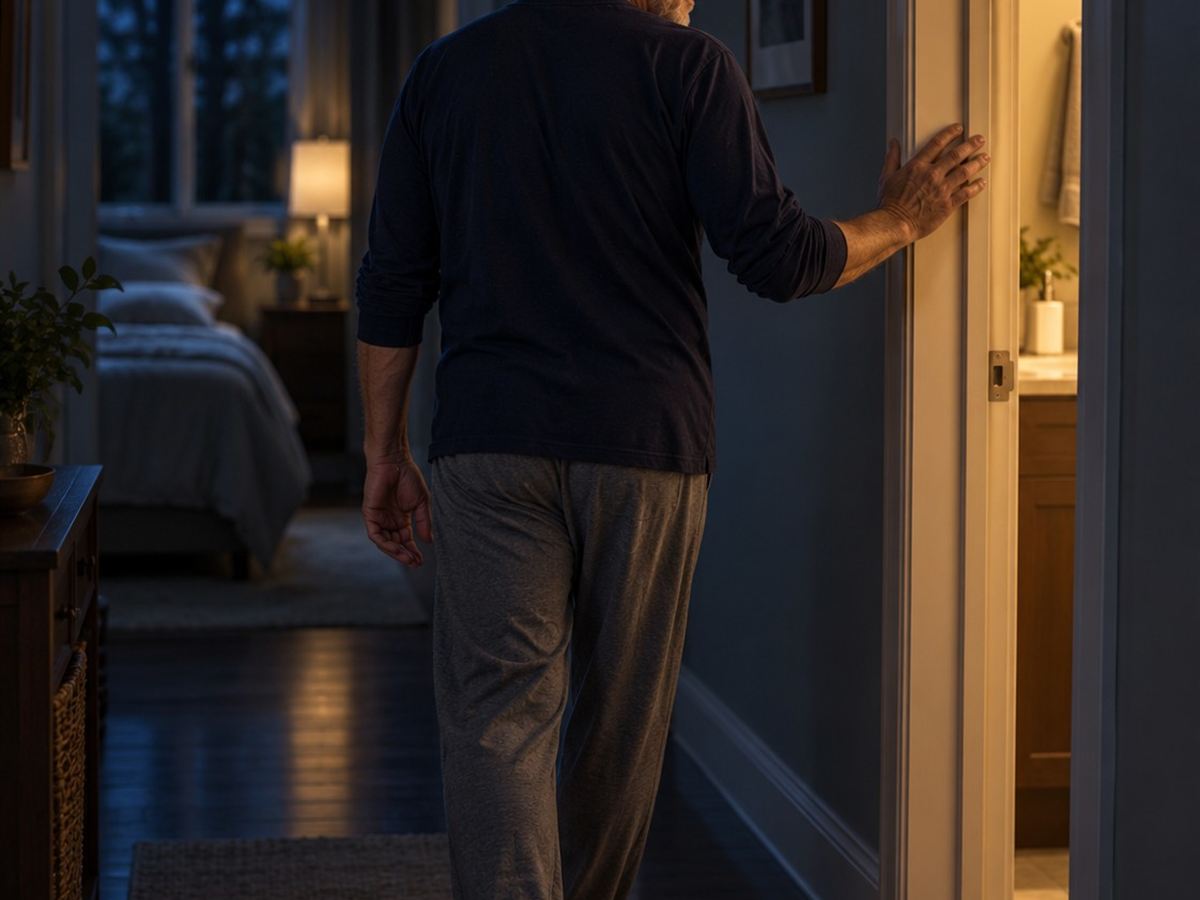
Sound familiar?
- You wake up at night to use the bathroom, then lie there trying to fall back asleep.
- Your stream seems weaker or slower, or it stops and starts.
- You feel like your bladder is not quite empty when you finish, or you dribble afterward.
- You check where the bathroom is before you leave the house.
- You are tired the next day and wonder whether this is just getting older.
None of this is shameful, and it is common. The useful question is not "Is this normal?" but "What is causing it in my case?"
Common reasons men wake up to urinate
Doctors call waking at night to urinate nocturia. It rarely has one single cause. These are the ones clinicians commonly look at:
An enlarged prostate (BPH)
The prostate sits around the tube that carries urine out of the bladder. As it grows with age, it can squeeze that tube, which may cause a weak stream, hesitancy, dribbling and frequent trips. BPH is not cancer.
How much you make at night
Some people produce more urine overnight, for example after evening fluids, caffeine or alcohol, or because of swelling in the legs that drains when lying down.
Bladder problems
An overactive bladder can create sudden urgency even when the bladder is not full.
Blood sugar and other conditions
Diabetes or high blood sugar, sleep apnea, and heart or kidney conditions can all increase nighttime urination.
Medicines
Some medicines, such as water pills (diuretics), can raise urine output, especially if taken late in the day.
Infection or inflammation
A urinary tract infection or prostate inflammation can cause urgency, burning and frequent trips, and needs medical care.
Independent references: NIDDK on enlarged prostate (BPH) and NIDDK on bladder control problems.
Questions that help your doctor
- How many times do you wake up, and since when?
- Do you drink more fluids, caffeine or alcohol in the evening?
- Which medicines do you take, and at what time of day?
- Do you also notice a weak stream, hesitancy, dribbling or urgency?
- Do you snore, or has anyone noticed you stop breathing in your sleep?
Writing the answers down for a few days (a "bladder diary") makes the visit far more useful.
When to see a doctor
Get medical care right away if you cannot urinate, have severe belly pain, fever or chills, or see blood in your urine (NIDDK on urinary retention).
Book a visit soon if the symptoms are new, getting worse, or are costing you sleep. A clinician can check your prostate, test for diabetes and infection, review your medicines, and rule out other causes.
What about insulin? A theory worth understanding
Most explanations stop at the prostate. The video we review goes one step further and asks whether high insulin in the blood could be involved in why the prostate grows. The narrator presents it as a hidden cause that many doctors overlook. Here is where the evidence stands, in plain words:
- Researchers do study links between metabolic health (such as insulin resistance and type 2 diabetes) and prostate enlargement, and the topic is discussed in the medical literature.
- That is different from showing that high insulin is the cause. The NIDDK says the exact causes of BPH are not fully understood.
- Urinary symptoms can also come from the bladder, sleep, medicines, infection and more, so one theory cannot explain every case.
The practical takeaway: metabolic health is a fair thing to ask your doctor about, especially if you have diabetes or a family history of it. It is not a reason to skip an evaluation.
View options and prices
Our independent REVIEW of the Protoflow video
The video promotes Protoflow, a dietary supplement sold by PhytoThrive Labs (Aurora, Colorado). We are affiliates, not the makers. We did not run a clinical test, and we did not take the product. Our review is of what the video says and how well it holds up. For the full label, price and guarantee, read our complete Protoflow review.
What the video does well
- Describes common symptoms in recognizable terms.
- Explains that the prostate surrounds the urinary tube, which is accurate.
- Raises a metabolic question that some researchers do study.
- States a 60-day money-back guarantee, which we confirmed on the official site.
What to be careful about
- It presents insulin as a hidden cause. That is a theory, not a settled fact.
- It cites many universities and institutions without giving references we could check, so we cannot confirm that they support the product.
- The narrator's credentials, and those of the experts named, are not documented on the page.
- It uses fear and distrust of conventional care, and a countdown timer, to drive urgency. Be wary of that in any health sales video.
- It blurs the line between a benign enlarged prostate and more serious conditions. They are not the same.
How to watch it critically
- Ask: is this a claim, or is a study named that I can look up?
- Notice every time the video creates urgency, and pause before deciding.
- Check any institution it names on that institution's own site.
- Remember that a testimonial or a story is not evidence.
- Write down your questions and bring them to your doctor.
Quick facts about the product (from the official site)
- What it is: an herbal dietary supplement. The label lists ingredients including saw palmetto, damiana, ginkgo, Chinese ginseng, tribulus, muira puama, epimedium, niacin and vitamin E. It contains soy and gelatin.
- Suggested use: 2 capsules a day (a 60-capsule bottle is about 30 days).
- Price: from about $49 to $79 per bottle depending on the package. Prices checked October 18, 2026, and they can change.
- Shipping: in the United States, $9.95 or free depending on the package (5 to 8 business days on the mainland). The maker also ships to Canada, the United Kingdom, Ireland, Australia and New Zealand for $19.95, usually in 12 to 20 business days. Prices are in US dollars, and your local rules, duties or taxes may apply.
- Guarantee: 60 days. A refund requires returning the bottles.
- Not a medicine: the FDA has not evaluated it to diagnose, treat, cure or prevent any disease.
Who it may suit: adults who have already talked with a clinician, are comfortable with an herbal supplement, and want to hear the maker's own explanation. Who should skip or ask first: anyone with sudden or severe symptoms, anyone taking prostate, blood pressure, blood thinning or diabetes medicines, and anyone allergic to soy or gelatin.
Ready to compare options? View package prices, shipping information and purchase terms on the manufacturer's offer page.
View options and prices
Affiliate link. We may earn a commission at no extra cost to you.

Small changes people often discuss with their doctor
These are general habits, not a treatment plan, and they are worth raising with a clinician:
- Moving most of your fluids earlier in the day, and easing off in the last two or three hours before bed.
- Noticing caffeine and alcohol in the evening.
- Asking whether the timing of any medicine could be changed.
- Keeping a few days of notes on when you drink and when you wake.
- Asking about a sleep check if you snore loudly.
Frequently asked questions
What is the most common cause of nocturia?
There is no single most common cause. In men, an enlarged prostate (BPH) is a frequent contributor, but so is making more urine at night (evening fluids, caffeine, alcohol, or swelling in the legs that drains when lying down), an overactive bladder, diabetes, sleep apnea and some medicines. A clinician can sort out which of these applies to you.
What is the best remedy for nocturia?
It depends on the cause, so there is no single best remedy. Clinicians often start by looking at when you drink fluids, caffeine and alcohol, your medicines, sleep apnea and blood sugar, and they may treat an enlarged prostate or an overactive bladder. We do not claim that any supplement treats nocturia. Ask your doctor what fits your situation.
How many times a night is it normal to pee?
Waking once during the night is common, and it becomes more common with age. Many clinicians start to pay closer attention when it happens two or more times a night, or when it keeps you from getting enough sleep. What matters most is a change from your usual pattern and how much it bothers you. If it is new or disruptive, mention it to a clinician.
What happens if nocturia is left untreated?
That depends on the cause. Broken sleep can leave you tired and affect mood and focus, and getting up in the dark raises the risk of a fall, especially for older adults. The underlying cause, such as diabetes, sleep apnea or a blocked bladder outlet, may also need care. Sudden or severe symptoms need prompt medical attention.
Does an enlarged prostate mean I have prostate cancer?
No. Benign prostatic hyperplasia (BPH) is a non-cancerous enlargement. It can cause similar urinary symptoms to other conditions, which is one reason a proper evaluation matters. Only a clinician can tell you what is behind your symptoms.
Is high insulin the proven cause of an enlarged prostate?
No. Researchers study links between metabolic health and prostate enlargement, but the NIDDK states the exact causes of BPH are not fully understood. The insulin idea in the video is one theory, not an established single cause.
Is the video in this review proof that the product works?
No. It is a sales presentation from the manufacturer. It makes claims and cites institutions, but it does not give us full references we could verify. Treat it as marketing, not as clinical evidence.
Can a supplement treat or cure an enlarged prostate?
Supplements are not intended to diagnose, treat, cure or prevent any disease. Some people choose to take them as part of a routine, but they do not replace an evaluation or the care your clinician recommends.
Do you get paid if I buy?
Yes. If you use the links on this page and buy, we may earn a commission from the seller, at no extra cost to you. That is why we label this page a REVIEW and tell you what we could not verify.
View options and prices
Affiliate link. We may earn a commission at no extra cost to you.
How we wrote this page
- We explain first, and promote second. The causes and warning signs come before any product.
- We attribute claims. What the video says is labeled as the video's claim.
- We never invent people. There are no customer stories here. Images are AI-generated illustrations and are not customers.
- We tell you how we are paid. See the affiliate disclosure and the medical disclaimer.
- We fix mistakes. Write to us through the contact page.
By the Clear Health Reviews editorial team · Updated October 20, 2026 · Prices checked October 18, 2026. This page is for information only and is not medical advice.